



Carbon monoxide (CO) is a colorless, odorless, and toxic gas that is difficult for humans to detect without specialized equipment. It can be produced when fuels such as natural gas, coal, gasoline, and wood do not burn completely. If indoor ventilation is inadequate and carbon monoxide continues to accumulate, it may pose a serious threat to human health.
For this reason, carbon monoxide alarms have become an important safety monitoring device in homes, apartments, hotels, RVs, boiler rooms, and other locations where fuel-burning appliances are used.
When choosing a carbon monoxide alarm, one of the most common questions is: At what CO concentration will the alarm sound?
In fact, a carbon monoxide alarm is not triggered simply by reaching one fixed concentration. Its alarm response is generally determined by both the carbon monoxide concentration and the duration of exposure.
一、Carbon Monoxide Concentration Is Usually Measured in ppm
Carbon monoxide alarms typically measure CO concentration in ppm (parts per million). In simple terms, ppm indicates the proportion of carbon monoxide present in the air per one million parts.
Under normal conditions, carbon monoxide levels are generally low. However, when appliances such as gas water heaters, gas boilers, fireplaces, gas stoves, or vehicle engines experience incomplete combustion, the CO concentration in the surrounding environment may continue to rise. As the concentration increases, the potential risk to human health also increases.
Therefore, a carbon monoxide alarm needs to continuously monitor the CO concentration in the surrounding air and determine whether an alarm should be activated based on both the concentration level and the duration of exposure.
二、A Carbon Monoxide Alarm Does Not Sound Immediately at a Specific Concentration
Many people assume that a carbon monoxide alarm will sound immediately once the concentration reaches 50 ppm. In practice, this is not necessarily the case.
Carbon monoxide alarms that comply with relevant standards generally use a time-and-concentration-based response mechanism. At lower CO concentrations, the gas usually needs to remain present for a certain period before the alarm is triggered. At higher concentrations, the alarm responds much more quickly.
Taking the alarm logic commonly associated with EN 50291 in the European market as an example:
When the carbon monoxide concentration is approximately 50 ppm, the alarm generally activates only after the concentration has remained at that level for a certain period, with a typical response range of 60 to 90 minutes.
When the carbon monoxide concentration reaches approximately 100 ppm, the response time becomes significantly shorter, and the alarm will typically be triggered within 10 to 40 minutes.
When the concentration reaches approximately 300 ppm, the level of risk has increased considerably. In this situation, the alarm needs to respond rapidly and should generally sound within 3 minutes.
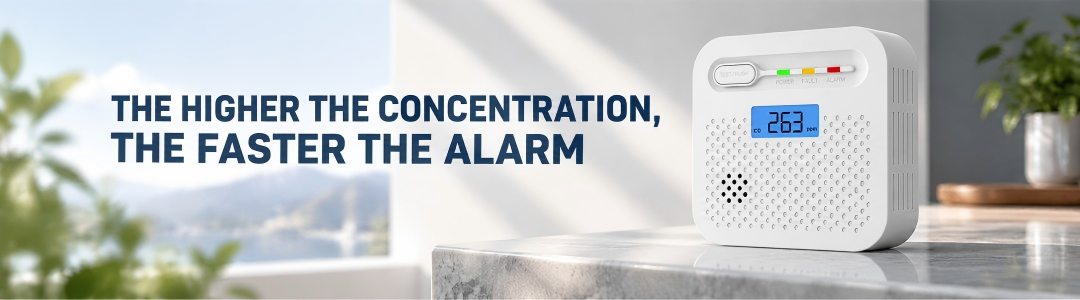
This demonstrates the basic operating principle of a carbon monoxide alarm: the higher the CO concentration, the faster the alarm response.
This type of design enables the alarm to continuously monitor potential carbon monoxide risks while also reducing unnecessary alarms caused by brief fluctuations in CO concentration.
三、A CO Reading on the Display Does Not Necessarily Mean an Immediate Alarm
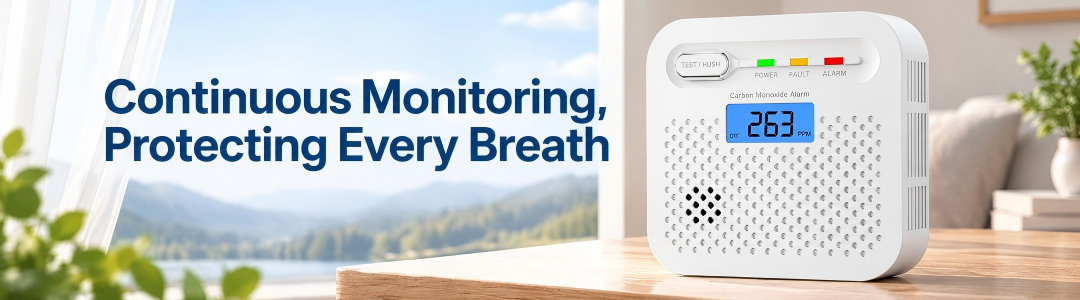
Many carbon monoxide alarms are now equipped with an LCD display that can show the current or periodically measured CO concentration, such as 30 ppm, 50 ppm, or 100 ppm.
It is important to understand that a displayed CO concentration does not necessarily mean that the alarm will sound at the same moment.
The main purpose of the display is to help users understand the current carbon monoxide level in the surrounding environment. Whether the alarm is actually triggered depends on several factors, including the CO concentration, the duration of exposure, and the relevant standards followed by the product.
Therefore, a carbon monoxide alarm with an LCD display not only provides an alarm function but also allows users to monitor changes in environmental CO concentration more intuitively.
四、Different CO Concentrations Correspond to Different Levels of Risk
The effects of carbon monoxide on the human body are closely related to both its concentration and the duration of exposure.
Short-term exposure to a relatively low concentration may not cause obvious symptoms. However, if carbon monoxide continues to accumulate or a person remains in a CO-containing environment for an extended period, symptoms such as headaches, dizziness, weakness, and nausea may gradually occur. As the concentration increases further, the associated risk also increases.
This is why continuous monitoring is an important function of a carbon monoxide alarm.
Rather than waiting until the carbon monoxide concentration reaches an extremely dangerous level before responding, the alarm continuously monitors CO levels in the air, evaluates potential risks based on changes in concentration, and provides audible and visual warnings when the alarm conditions are met.
五、Where Should Carbon Monoxide Alarms Be Used?
Residential homes are among the most common applications for carbon monoxide alarms. Households that use gas water heaters, gas stoves, fireplaces, gas boilers, or other fuel-burning appliances should pay particular attention to carbon monoxide safety monitoring.
Hotels, apartments, and rental properties often accommodate a relatively large number of people. If these locations contain gas appliances, boilers, or other combustion equipment, carbon monoxide alarms can serve as an important additional measure for routine safety management.
RVs also represent an important application for CO alarms. Their interior spaces are relatively enclosed and may contain gas-powered heating or cooking equipment. If ventilation is insufficient, carbon monoxide may accumulate.
In addition, boiler rooms, equipment rooms, and other areas where fuel-burning equipment is used should be equipped with appropriate carbon monoxide detection and alarm devices according to the actual operating environment.
六、Key Factors When Choosing a Carbon Monoxide Alarm
When selecting a carbon monoxide alarm, it is not advisable to focus only on price or product appearance. Greater attention should be given to the product’s detection performance and long-term stability.
The first important factor is sensor performance. The carbon monoxide sensor is the core component of the alarm, and its stability directly affects the accuracy of CO concentration detection and the reliability of the alarm.
The second factor is alarm response performance. At different carbon monoxide concentrations, the alarm needs to respond within specified time ranges. Therefore, alarm response time is one of the key indicators used to evaluate product performance.
Battery life is also an important consideration. For long-term applications in homes, apartments, hotels, and similar locations, a long-life battery can help reduce routine maintenance requirements and the cost associated with frequent battery replacement.
In addition, functions such as low-battery warnings, fault warnings, end-of-life warnings, a TEST function, and a HUSH function can improve the reliability and convenience of the product during long-term use.
For products intended for export to the European market, particular attention should also be paid to relevant standards and certification requirements such as EN 50291.
七、Continuous Monitoring Is More Important Than a Single Alarm Threshold
The true value of a carbon monoxide alarm lies not simply in detecting one specific concentration level, but in continuously monitoring changes in CO levels in the surrounding environment.
At lower concentrations, the alarm evaluates the potential risk by considering how long the CO remains present. As the concentration increases, the required alarm response time becomes progressively shorter. When a relatively high concentration of carbon monoxide is detected, the alarm needs to respond quickly so that people can take appropriate action in time.
Therefore, when choosing a carbon monoxide alarm, users should focus on factors such as sensor stability, alarm response time, battery life, alarm sound pressure, and applicable certification standards, rather than comparing products based solely on price.
For homes, hotels, apartments, RVs, and other locations where fuel-burning equipment is present, properly installing suitable carbon monoxide alarms and testing them regularly in accordance with the product instructions can further improve carbon monoxide safety monitoring.
As awareness of carbon monoxide safety continues to grow, CO alarms are evolving from simple on-site warning devices toward products that offer greater stability, longer service life, and easier management.
For carbon monoxide alarm manufacturers, continuously improving sensor performance, alarm accuracy, product reliability, and certification capabilities for different markets will become increasingly important components of overall product competitiveness.
Post time: Sep-23-2026