



Smoke alarms are typically required to operate continuously for many years. Although they remain idle most of the time, their internal sensors, electronic components, batteries, sounders, and smoke-sensing chambers are always operating or in standby mode and are continuously affected by the surrounding environment.
High temperatures, high humidity, low temperatures, and rapid temperature changes can all affect the operational stability of a smoke alarm. Whether a product is suitable for a specific environment should be determined based on its instructions and actual test results; a conclusion should not be drawn from a single functional test performed at room temperature.
1. What Effects Can High-Temperature Environments Have?
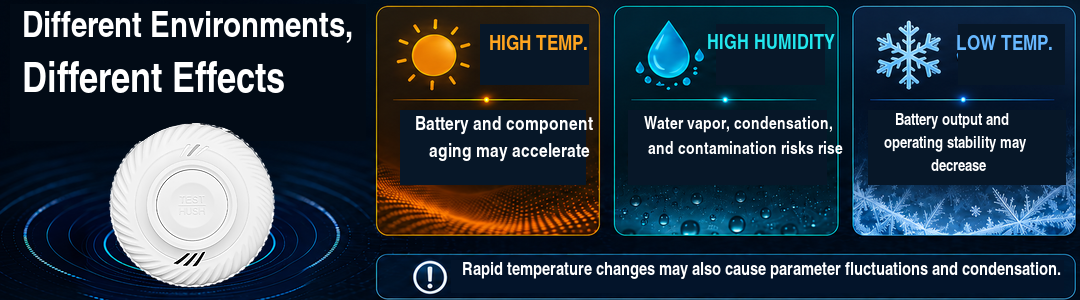
When a smoke alarm is exposed to high temperatures over an extended period, its battery, electronic components, and structural materials may be affected to varying degrees.
High ambient temperatures may accelerate battery aging, affecting service life and output stability. At the same time, the operating parameters of components such as the photoelectric emitter, receiver, control circuit, and sounder may also drift to some extent as the temperature changes.
For a photoelectric smoke alarm, the internal optical components and detection circuit must maintain a relatively stable baseline. If the ambient temperature significantly exceeds the range specified for the product, the stability of smoke-signal detection may be affected. Products with temperature compensation can reduce the effects of ambient temperature changes within a certain range, but this compensation is not unlimited.
Prolonged high temperatures may also accelerate the aging of the housing, sealing materials, and internal structure. Some materials may deform, become brittle, or lose sealing effectiveness, increasing the risk that dust, insects, and other contaminants will enter the sensing chamber.
Therefore, standard residential smoke alarms should not be installed directly in uninsulated attics, boiler rooms, equipment rooms, or other areas subject to prolonged high temperatures unless the product is explicitly specified as suitable for those environments.
2. Why Can High-Humidity Environments Cause False Alarms?
The effects of high humidity on smoke alarms are mainly related to water vapor, condensation, and internal contamination.
Photoelectric smoke alarms determine whether smoke is present by detecting changes in the way smoke particles scatter light. When large amounts of water vapor or fine condensation droplets enter the sensing chamber, they may also scatter light. Under certain conditions, the device may interpret water vapor or condensation droplets as an abnormal signal, resulting in a non-fire alarm.
It is important to note that high relative humidity does not necessarily lead directly to false alarms. The actual effect also depends on how long the high humidity persists, the ambient temperature, airflow, whether conditions for condensation are reached, and the design of the sensing chamber. When the air temperature approaches the dew point, water vapor is more likely to condense inside the product or on the mounting surface, increasing the likelihood of false alarms.
Long-term exposure to high humidity may also make dust more likely to adhere to the inside of the sensing chamber and increase the risk of metal parts, battery contacts, and the circuit board becoming damp or corroded.
Therefore, smoke alarms should generally not be installed in bathrooms, shower rooms, near steam outlets, or in locations where condensation occurs over extended periods. In areas such as kitchens and laundry rooms, where water vapor and cooking fumes are common, the product type and installation location should be selected according to actual environmental conditions.
3. Does a Low-Temperature Environment Affect Alarm Function?
Low temperatures may affect a smoke alarm’s battery power delivery, the operating state of its electronic components, and the reliability of its materials.
As the temperature decreases, the internal resistance of some batteries may increase, reducing their instantaneous output capability. When activating the sounder, strobe light, or wireless communication function, a smoke alarm typically requires more current than it does in standby mode. If the battery has aged or the product remains for an extended period in a low-temperature environment outside the specified range, low-battery warnings may occur prematurely, alarm sound output may become unstable, or communication functions may operate abnormally.
Low temperatures may also alter the operating parameters of some electronic components. If a product lacks sufficient environmental compensation and has not undergone adequate low-temperature testing, its detection baseline and operational stability may be affected.
However, this does not mean that a smoke alarm will necessarily fail to sound when the temperature drops. It means that performance uncertainty increases when the environment falls outside the product’s specified operating range.
In addition, when a device is moved from a cold environment into a warm, humid space, condensation may form inside it or on its surface. This combination of low temperature and high humidity is more easily overlooked than a consistently low temperature.
4. Rapid Temperature Changes Also Require Attention
Temperatures in actual use environments do not usually remain constant. Differences between daytime and nighttime temperatures, seasonal changes, air-conditioning cycles, and alternation between hot and cold air may all subject a smoke alarm to repeated temperature changes.
Rapid temperature changes may cause internal materials to expand and contract repeatedly while also increasing the risk of condensation. Smoke alarms installed beneath uninsulated roofs, near exterior walls, near air-conditioning supply vents, or at boundaries between warm and cold areas are more likely to be affected by these conditions.
Airflow can also alter the path by which smoke reaches an alarm. If a device is installed near a forced-air supply vent, return-air vent, or fan, smoke may be diluted, blown away, or redirected by the airflow. Therefore, when installing a smoke alarm, temperature and humidity are not the only factors to consider; the building structure and airflow conditions must also be taken into account.
5. How Should Environmental Suitability Be Verified?
A smoke alarm’s environmental suitability cannot be assessed merely by pressing the test button once at room temperature. The test button is primarily used to check whether the control circuit, sounder, and certain functions are operating correctly. It cannot fully replace actual smoke response testing or environmental reliability validation.
Smoke response: Whether the smoke alarm’s response remains stable before and after environmental conditioning;
Smoke-free conditions: Whether false alarms or persistent warning signals occur when no smoke is present;
Alarm output: Whether the sounder’s sound pressure level remains within the design specification;
Power supply: Whether battery voltage and standby power consumption remain within normal limits and the low-battery warning function operates correctly;
Structural inspection: Whether the sensing chamber, housing, circuit board, or connections show deformation, corrosion, or condensation;
Functional inspection: Whether self-test, silence, interconnection, and wireless communication functions operate normally;
Recovery capability: Whether the product can operate stably after being returned to normal environmental conditions;
Batch consistency: Whether test results remain consistent among products from the same batch.
Specific test temperatures, humidity levels, durations, and acceptance criteria should be determined based on the product’s design range, intended use, and applicable requirements. The same set of test parameters should not be applied to all smoke alarms.
6. Proper Installation and Maintenance Are Equally Important
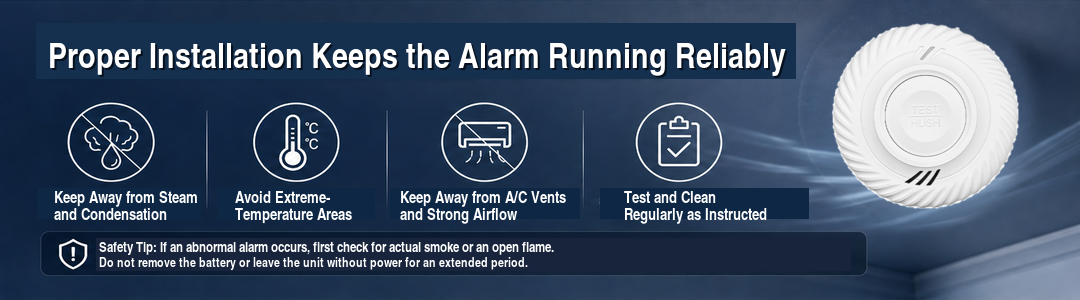
To reduce the effects of environmental factors, smoke alarms should be installed in the locations specified in the product instructions and should, as far as possible, be protected from prolonged exposure to steam, condensation, extreme temperatures, and strong airflow.
Humid areas: Do not install standard smoke alarms in bathrooms, shower rooms, or near steam outlets.
Extreme temperatures: Avoid installation in uninsulated attics, garages, or spaces with significant temperature fluctuations.
Airflow: Avoid locations near air-conditioning supply vents, return-air vents, and areas of strong airflow.
Obstruction: Do not paint the surface of the alarm, cover it with decorative materials, or allow dust to accumulate on it.
Routine maintenance: Perform functional tests and cleaning regularly in accordance with the product instructions.
Responding to unexpected alarms: If an unexpected alarm occurs, first confirm whether actual smoke or a smoldering fire source is present. Do not address an unexpected alarm by removing the battery or disconnecting the power for an extended period.
7. Conclusion
High-temperature, high-humidity, and low-temperature environments can all affect smoke alarms, but the effects are not identical. High temperatures may accelerate the aging of batteries, components, and structural materials; high humidity and condensation may increase the risk of false alarms and internal corrosion; low temperatures may affect battery output and the operating stability of electronic components; and rapid temperature changes may cause both parameter fluctuations and condensation.
The reliability of a smoke alarm is demonstrated not only by its ability to sound an alarm at room temperature, but also by its ability to maintain stable detection, alarm, and self-test functions after long-term operation within its specified environmental range. Therefore, temperature, humidity, airflow, and other environmental factors should be fully considered during product design, procurement acceptance testing, and actual installation.
Post time: Aug-13-2026