



For renovation projects involving older European homes, guesthouses, and apartments, Wi-Fi + RF interconnected wireless smoke alarms should be the first choice. They require no wall cutting or cabling, preserve the building’s original appearance, meet the EU’s mandatory EN 14604 requirements, and provide real-time remote alerts on a mobile phone. This directly addresses the three major shortcomings of traditional wired alarms: complicated installation, no monitoring when the property is unattended, and delayed response to a fire. It is currently the ideal solution for safety upgrades in Europe’s existing housing stock.
In European property safety renovation projects, traditional wired smoke alarms no longer meet market needs. This is especially true for buildings more than 20 years old, many of which have reinforced-concrete walls and complex service routes. Retrofitting cables is not only expensive but can also damage facades and interior finishes and may even violate local rules protecting older buildings. ARIZA wireless smart smoke alarms are designed for the European renovation market, combining compliance, convenience, and smart functionality for homes, guesthouses, and small commercial premises.
I. Background: Why Wired Alarms Have Become a Procurement Pitfall in European Renovation Projects
In recent years, European countries have continued to tighten residential fire-safety regulations. The EU implements the EN 14604 safety standard for smoke alarms, requiring all residential properties, commercially operated guesthouses, and rental apartments to be equipped with compliant smoke-detection devices. New-build and renovation projects increasingly prioritize smart alarm systems that support interconnection and remote monitoring.
These policies are forcing property operators and project buyers across Europe to upgrade their equipment. However, many buyers still fall into a common trap: purchasing outdated wired smoke alarms and creating multiple risks:
1. Renovation costs exceed budget: Labor, interior renovation, and repair costs are extremely high in Europe. Wired devices require channels to be cut into walls, cables to be routed, and connections to mains power. For a single property, the labor cost alone can exceed the cost of the equipment, significantly reducing project margins.
2. Risk of non-compliant alterations: Many buildings in older European cities are protected by heritage regulations that prohibit unauthorized wall cutting and exposed cable runs. Wired retrofits can easily result in corrective-work orders and fines.
3. Gaps in safety monitoring: Traditional wired alarms provide only on-site audible and visual alerts. Guesthouses and short-term rental apartments are often unattended for extended periods, so owners and operators cannot learn about a fire promptly when they are away. This can delay emergency response and lead to property loss and liability disputes.
4. Complicated after-sales maintenance: Aging cables and difficult fault diagnosis make wired systems expensive to maintain, which is inconsistent with the European market’s shift toward simplified operations and maintenance.
These issues affect two customer groups in particular: European guesthouse and short-term rental operators, and project procurement firms renovating older residential properties. They are also among the main pain points in current European security-equipment procurement.
II. Product Comparison: The Difference Between Wired and Wireless Smart Smoke Alarms at a Glance
Based on a real bulk-renovation project for guesthouses in Slovenia, the following comparison highlights the key differences between traditional wired alarms and ARIZA Wi-Fi wireless smart alarms:
1. Installation: Traditional wired smoke alarms require wall cutting, cabling, and a mains power connection. The process is complex and can damage interior finishes. ARIZA Wi-Fi wireless smart smoke alarms require no cabling or wall cutting and can be mounted with adhesive or screws; one unit can be installed in about 10 minutes.
2. Suitable applications: Traditional wired smoke alarms are generally suitable only for unfinished new-build properties, making them difficult to retrofit in older or already-finished buildings. ARIZA Wi-Fi wireless smart smoke alarms can be used in older homes, guesthouses, apartments, shops, and other settings.
3. Alert methods: Traditional wired smoke alarms provide only on-site audible and visual alerts, so they cannot give timely warning when the property is unattended. ARIZA Wi-Fi wireless smart smoke alarms combine on-site audible and visual alerts with remote app notifications, allowing users to receive fire alerts wherever they are.
4. Maintenance costs: Traditional wired smoke alarms are vulnerable to aging cables, difficult fault diagnosis, and high repair costs. ARIZA Wi-Fi wireless smart smoke alarms use a 10-year long-life battery and require neither frequent battery replacement nor cable maintenance, reducing the maintenance burden.
5. Compliance: Traditional wired smoke alarms meet only basic detection requirements, lack smart interconnection, and do not meet the EU’s new renovation requirements. ARIZA Wi-Fi wireless smart smoke alarms carry EN 14604 and CE certifications, support smart interconnection, and fully meet the latest European requirements.
III. Practical Solution: Four Core Advantages That Address Every Challenge in European Renovation Projects
1. Wireless, Cable-Free Installation for Compliance with Renovation Rules in Older European Buildings
To comply with rules in Slovenia and other European countries that prohibit structural alterations to older buildings, ARIZA wireless smoke alarms eliminate wired installation altogether. Each device has a built-in long-life battery and requires neither a mains power connection nor cable routing. Installers simply secure the unit with base screws or heavy-duty adhesive. Installation time for an entire guesthouse can be reduced by 80%, with no damage to walls or ceilings. This helps avoid violations of local building-renovation rules while significantly reducing labor and refurbishment costs.
2. Remote Wi-Fi Connectivity That Eliminates the Limits of On-Site Monitoring
This is the most important advantage of smart devices over traditional systems. Conventional wired alarms can sound only on site, while guesthouses and rental apartments are often routinely unattended. When a fire occurs, this can easily delay the response.
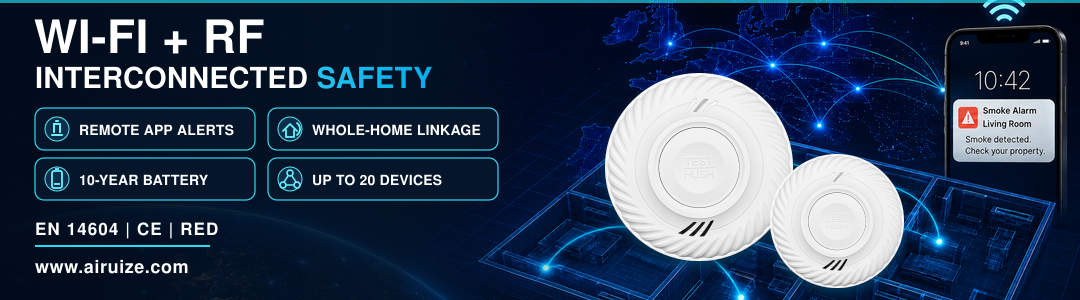
Our devices use a Tuya-certified Wi-Fi module and support stable 2.4 GHz connectivity. Once paired with the Smart Life app, the alarm immediately sends a notification to the user’s phone whenever an abnormal smoke condition is detected, regardless of where the owner or operator is located. The alert shows the alarm location and device status, enabling 24/7 remote safety monitoring. This closes the monitoring gap when a property is unattended and significantly reduces operational safety risks for guesthouses.
3. RF Interconnection for Safer, Property-Wide Simultaneous Alerts
In addition to remote phone notifications, the devices support 433/868 MHz RF wireless interconnection on frequency bands commonly used in Europe. Multiple alarms can be linked within one property. If any unit detects a fire, all alarms sound and flash simultaneously, prompting occupants to evacuate quickly. The devices also feature an anti-interference shielding design that helps withstand signal interference from reinforced-concrete walls and densely installed appliances in older European buildings. Tests in complex layouts achieved a signal stability rate of 99.8%. Up to 20 devices can be interconnected reliably, meeting the networking needs of small or large properties and multi-story guesthouses.
4. Strong Compliance and a Low False-Alarm Rate for Europe’s Stringent Market Requirements
All products are certified by TÜV Rheinland and comply strictly with the EU’s EN 14604 smoke-alarm standard and CE safety requirements. They meet fire-safety inspection requirements across Europe and can be used for property registration and fire inspections. Dual-optical-path photoelectric sensing and smart algorithms filter interference from cooking fumes, water vapor, and dust. Tests show a false-alarm rate below 0.3%, well under the industry average, helping guesthouse operators avoid occupant complaints and neighbor disputes caused by repeated false alarms. A 10-year long-life battery eliminates the need for battery replacement and frequent maintenance during its service life, supporting the European market’s preference for simplified operations and maintenance.
IV. Customer Case Study: Bulk Renovation of 28 Guesthouse Properties in Slovenia
Customer background: A local guesthouse operator in Ljubljana, Slovenia, managed 28 guesthouse properties in older residential buildings. The buildings were more than 30 years old and had reinforced-concrete walls. Local policy prohibited unauthorized wall demolition or cable installation. The existing wired alarms had aged and failed, preventing the properties from passing their annual fire-safety inspections. The customer urgently needed to replace them in bulk with compliant equipment.
Key customer requirements: No cabling, no damage to the original buildings, compliance with EU fire-safety standards, remote monitoring, lower long-term maintenance costs, and rapid completion of the bulk retrofit in time to pass the annual inspection.
Implementation and test data:
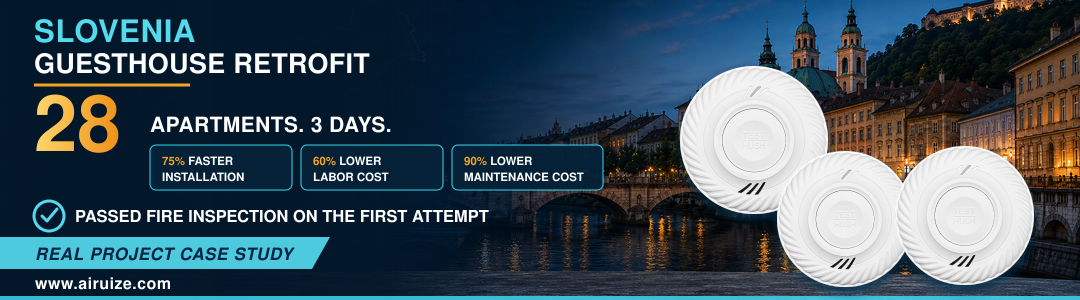
1. Installation: We supplied S100B-CR-W Wi-Fi + RF interconnected smoke alarms. The entire project required no wall cutting or cabling. Two installers completed installation and commissioning across all 28 properties in three days. Compared with a traditional wired retrofit, the project schedule was shortened by 75% and labor costs were reduced by 60%. No structural elements were altered, and the work fully complied with local renovation rules for older buildings.
2. Functional testing: After the devices were networked in bulk, property-wide interconnection response time was no more than 2 seconds. Fire-detection response met European requirements (no more than 120 seconds for a smoldering fire and no more than 60 seconds for an open flame). Remote app notifications arrived within 1 second, allowing the customer to monitor device status and fire warnings for every property in real time while traveling abroad.
3. Compliance acceptance: We supplied a complete set of EN 14604, CE, and RED certificates and test reports. All devices passed the local annual fire-safety inspection on the first attempt, with no corrective work required.
4. Long-term maintenance: The devices provide a 10-year battery life and perform an automatic weekly self-test, eliminating the need for frequent manual checks. This addressed the main problems of the old equipment, including wiring faults, missed battery checks, and frequent maintenance, and reduced the customer’s annual maintenance costs by 90%.
Customer feedback: “The cable-free design solved the biggest challenge in renovating our older guesthouses. Remote monitoring makes us feel more confident managing the properties from another location, and the compliance and stability far exceed those of our previous wired devices. We will use the same products in bulk for all new properties.”
V. Industry Experience and Procurement Pitfalls: Frequently Asked Questions
Drawing on 16 years of experience exporting security equipment to Europe, we have identified three key recommendations to help European buyers and contractors avoid common mistakes when purchasing and retrofitting smoke alarms:
1. Reject low-cost, uncertified products: Products for the European market must have valid EN 14604 certification. Some low-cost devices carry only a CE mark and lack a complete TÜV test report; they cannot pass fire-safety inspections and may lead to rework and fines. All our devices are supported by a full set of verifiable certificates and test reports for customer registration and verification.
2. Prioritize wireless models for older-building renovations: In more than 90% of renovation projects involving Europe’s existing housing stock, the total cost of wired devices, including labor, repairs, and corrective work, is much higher than that of wireless smart devices. Choosing a wired model without careful evaluation only increases project risk and cost. Wireless, smart technology has become an inevitable trend in European residential safety renovations.
3. Prioritize models with interconnection and remote monitoring: The EU’s latest fire-safety requirements are gradually promoting connected smart safety systems, and stand-alone alarms are expected to be phased out over time. Buyers should choose models that support remote Wi-Fi notifications and property-wide RF interconnection to accommodate future market upgrades and avoid premature product obsolescence.
VI. Conclusion
For smoke-alarm retrofits in older European homes, guesthouses, and apartments, the main challenge has never been detection alone. It lies in four issues: installation restrictions, high renovation costs, no warning when the property is unattended, and inadequate compliance.
With four core advantages, cable-free installation, real-time remote phone alerts, smart property-wide interconnection, and compliance with stringent EU standards, ARIZA Wi-Fi + RF wireless smart smoke alarms are ideally suited to the renovation market for Europe’s existing building stock. With 16 years of experience providing ODM/OEM security products for the European market and having served more than 3,000 brands worldwide, ARIZA has become a preferred partner for small and medium-sized property operators and project procurement firms in Europe, thanks to stable product quality, a comprehensive certification system, and proven implementation capabilities.
For a Europe-specific compliance solution, volume pricing, or certification documents, visit our website at https://www.airuize.com/ to contact our team.
Post time: Aug-18-2026