



In fire safety systems, timely smoke detection is an essential part of early fire warning. Some fires may undergo a period of smoldering and continuously produce smoke before visible flames appear. Effectively identifying changes in ambient smoke conditions is a key technical challenge that smoke alarms must address.
Photoelectric smoke detection technology uses the scattering of light by smoke particles to convert changes in optical signals into electrical signals that can be analyzed, providing a technical basis for detecting smoke from fires. This technology is now widely used in smoke detection and alarm devices.
I. What Is Photoelectric Smoke Detection Technology?
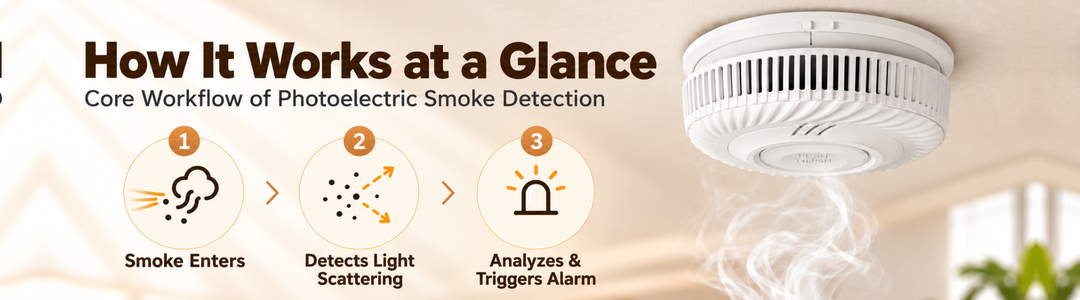
Photoelectric smoke detection technology is an optical method of detecting smoke. Its core principle is to use the light-scattering effect that occurs when smoke particles enter the sensing area to determine whether smoke in the environment meets the conditions for triggering an alarm.
Under normal monitoring conditions, the photoelectric sensor continuously monitors optical signals within the smoke-sensing area. When smoke particles enter the detection chamber, light that would otherwise travel in a particular direction is scattered. Some of this scattered light is captured by the light-receiving element, causing a change in the detected signal.
By processing and evaluating this signal, the alarm can identify smoke conditions that meet its preset criteria and activate the corresponding alarm function.
Unlike methods that directly detect temperature changes, photoelectric smoke detection primarily focuses on optical changes caused by airborne smoke particles. It is one of the key technologies used in smoke warning devices.
II. How Photoelectric Smoke Detection Works
A photoelectric smoke detection system typically consists of a light source, a light-receiving element, a smoke-sensing chamber, and signal-processing circuitry. Its operation generally involves the following steps.
1. Light Emission A light source inside the detector emits light into the smoke-sensing chamber. In a typical light-scattering photoelectric design, the light source and receiving element are positioned at specific angles so that direct light does not normally reach the receiver.
2. Smoke Enters the Detection Chamber When smoke is present in the surrounding environment, smoke particles are carried by airflow into the detector’s smoke-sensing area, where they interact with light traveling through the chamber.
3. Smoke Particles Scatter Light When light encounters smoke particles, some of it deviates from its original path, producing scattered light. A portion of this scattered light reaches the light-receiving element, changing the optical signal it detects.
4. Signal Analysis and Alarm Determination The light-receiving element converts the detected optical signal into an electrical signal, which is then processed by electronic circuitry or a microcontroller. When the detection result meets the device’s preset alarm criteria, the alarm activates its alarm output to alert people on-site to a potential fire risk.
This process enables the device to convert changes in smoke that are difficult to observe or quantify directly into analyzable electrical signals, allowing automated smoke monitoring.
III. What Are the Characteristics of Photoelectric Smoke Detection Technology?
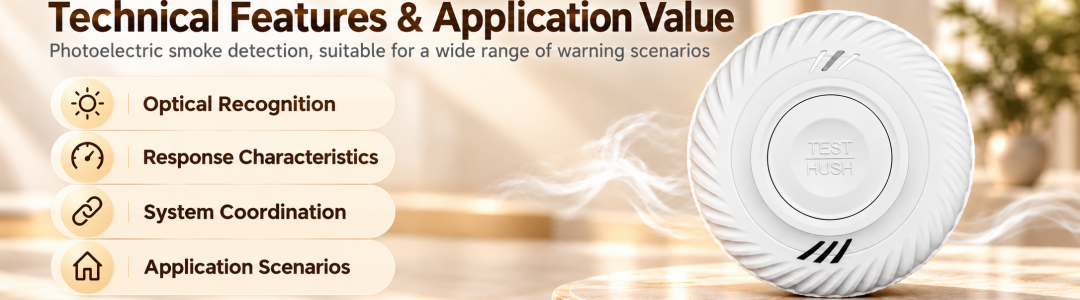
1. Smoke Detection Based on Optical Changes
Photoelectric smoke detection uses changes in light scattering caused by particles as the basis for detection. It can monitor smoke entering the sensing area without direct contact with flames. This method is suitable for fire warning devices whose primary purpose is smoke detection.
2. Good Response to Certain Types of Smoke from Smoldering Fires
During smoldering, some combustible materials produce smoke particles with particular particle-size distributions. Photoelectric detection technology generally responds well to certain types of smoke generated by smoldering fires, making it valuable for smoke warning in homes and other applicable locations.
It should be noted that smoke particle characteristics vary among different fires. A detector’s actual response is also affected by factors such as product design, detection algorithms, and environmental conditions.
3. Easy Integration with Electronic Control Systems
Detection signals from photoelectric sensors can be analyzed and evaluated by electronic control systems. In actual product designs, the smoke detection module can work with functions such as audible and visual alarms, battery status monitoring, and communication modules to form a complete fire smoke warning solution.
The smoke detection module senses environmental changes, while other functional modules handle tasks such as alarm notifications, status management, or information transmission, depending on the product design.
IV. What Factors Affect Smoke Detection Performance?
Photoelectric smoke detection does not mean that identical detection performance can be achieved in every environment. In practical applications, the following factors should be considered.
Smoke Particle Characteristics: Smoke produced by different burning materials and under different combustion conditions may vary in particle size, particle count, and optical properties, which can affect light-scattering signals.
Installation Location and Airflow: Smoke must enter the sensing area to be effectively detected. The installation location, airflow direction, and spatial layout may affect how smoke reaches the detector.
Interference from Dust and Water Vapor: Dust, steam, and other airborne particles can also scatter light and interfere with detection signals. Therefore, a suitable installation location should be selected based on the product’s intended operating environment.
Device Condition and Maintenance: After extended use, dust buildup or contamination inside the detection chamber may affect device operation. Regular inspections and maintenance in accordance with the product manual are important measures for keeping the device functioning properly.
Therefore, in addition to the detection technology itself, attention should also be paid to product design, proper installation, and routine maintenance.
V. Practical Applications and Value of Photoelectric Smoke Detection Technology
As fire warning devices become increasingly intelligent and connected, smoke detection technology not only serves to detect smoke at the site but also provides an important basis for intelligent fire warning systems to obtain information about on-site conditions.
In homes, apartments, offices, and other suitable environments, photoelectric smoke alarms can monitor changes in smoke within their detection range and issue an alert when alarm conditions are met. This provides early warning information that helps people further assess on-site conditions, evacuate to safety, and take emergency action.
For products equipped with connectivity features, relevant alarm status information can also be transmitted to a compatible platform through a communication module, helping management personnel promptly understand the information reported by the devices.
VI. Conclusion
By coordinating the light source, smoke-sensing chamber, light-receiving element, and signal-processing system, photoelectric smoke detection technology converts changes in light scattering caused by smoke particles into a basis for alarm decisions, providing an effective technical means of monitoring smoke associated with fires.
In practical applications, smoke detection performance depends not only on the sensor’s operating principle but also on the overall product design, installation environment, and maintenance management.
As sensor technology, electronic control technology, and Internet of Things (IoT) communication technology continue to develop, photoelectric smoke detection will remain an important technical foundation for fire warning devices and support the development of more comprehensive fire safety systems.
Post time: Oct-22-2026