



Smoke alarms are important components of building fire safety systems. By detecting changes in smoke conditions and sounding an alarm in the early stages of a fire, they provide valuable time for evacuation and fire response. However, in actual use, some smoke alarms may sound when no fire has occurred. This is commonly referred to as a false alarm.
False alarms are not necessarily caused by product quality issues. They may also be related to environmental conditions, installation locations, detection technologies, and equipment maintenance. Understanding these factors can help users operate smoke alarms correctly and improve the reliability of early fire warnings.
1. Why Do Smoke Alarms Produce False Alarms?
Common smoke alarms generally fall into two main categories: photoelectric and ionization. Photoelectric smoke alarms detect the presence of smoke by monitoring how smoke particles affect light.
Taking a typical light-scattering smoke alarm as an example, it contains an optical sensing chamber. When smoke particles enter the chamber, they alter the way light is scattered. A receiving element converts the detected optical signal into an electrical signal, which is then processed to determine whether the conditions for triggering an alarm have been met.
However, in real-world environments, dust, water mist, and other airborne particles, as well as smoke from fires, can affect optical detection signals. If these interference signals meet the alarm conditions set for the device, a false alarm may occur.
Therefore, false alarms from smoke alarms are closely related to the detection environment and the device’s ability to distinguish smoke from other particles.
2. Main Factors Affecting False Alarms in Smoke Alarms
1. Cooking Fumes and Particles Generated During Cooking
The kitchen is one of the places where smoke alarms are susceptible to interference from particles that are not produced by fires.
Cooking activities such as frying and baking can generate oil fumes and other airborne particles. When these particles enter a smoke alarm’s sensing chamber, they may alter the internal detection signals and trigger an alarm.
The likelihood of alarms caused by non-fire-related smoke increases, particularly when ventilation is poor or the smoke alarm is installed close to the cooking area.
Therefore, when installing smoke alarms, the location of the kitchen and the paths along which cooking fumes travel should be carefully considered to prevent the devices from being directly exposed to fumes from everyday cooking.
2. Steam and Changes in Ambient Humidity
Steam and high-humidity environments are also important factors affecting the operation of smoke alarms.
For example, steam generated by showering in a bathroom and water mist produced when boiling water in a kitchen may affect the detection results of photoelectric smoke alarms.
When humidity is high, or changes in ambient temperature cause water vapor to condense, the resulting tiny droplets may enter the optical sensing chamber and interfere with optical signals.
Therefore, standard smoke alarms should not be installed in locations where they are likely to be exposed to large amounts of steam. The device’s specified operating humidity range should also be observed.
3. Dust Accumulation and Airborne Particles
During long-term operation, airborne dust may gradually accumulate on smoke inlet openings or on surfaces inside the sensing chamber.
For photoelectric smoke alarms, accumulated dust may alter the optical conditions inside the sensing chamber, causing abnormal detection signals and increasing the risk of false alarms.
Renovation and construction work, woodworking, and other dust-generating activities may also increase the concentration of airborne particles and affect smoke detection.
Therefore, devices should be cleaned regularly in accordance with the product manual, and standard smoke alarms should not be installed directly in high-dust environments that exceed their specified operating conditions.
4. Installation Location and Airflow
The installation location of a smoke alarm affects not only its ability to detect smoke from fires but also its susceptibility to false alarms.
For example, alarms installed too close to kitchens or bathrooms may be affected by cooking fumes or water mist, while those installed near air-conditioning outlets or ventilation ducts may be affected by airflow.
Air movement changes the paths along which smoke and other airborne particles travel, exposing the device to varying particle concentrations. Strong airflow may also affect the process by which smoke from a fire enters the sensing chamber.
Therefore, smoke alarms should be positioned in accordance with applicable standards, building conditions, and the product’s installation instructions, taking into account both fire detection effectiveness and resistance to interference.
5. Insects Entering the Sensing Chamber
Some smoke alarms may be affected by small insects during operation.
When insects enter the optical sensing chamber, their movements, or their obstruction or scattering of light along the optical path, may cause changes in detection signals and lead to unintended alarms.
Therefore, the design of smoke inlets, insect-resistant features, and routine cleaning and maintenance can help reduce this type of interference.
It is important not to block smoke inlet openings to prevent insects from entering, as doing so may impair the device’s ability to detect smoke properly.
6. Device Aging and Internal Faults
In addition to environmental factors, the operating condition of a smoke alarm itself may affect the reliability of its alerts.
Over time, contamination of the sensing chamber, abnormalities in electronic components, or other internal faults may change the device’s detection performance.
In addition, low battery power may cause the device to issue a low-battery warning. It should be noted, however, that low-battery warnings, fault indications, and fire-related smoke alarms are different types of signals and should not all be classified as false alarms.
Users should refer to the product manual to identify different warning signals and address equipment faults promptly.
3. How Does Smoke Detection Technology Relate to False Alarms?
The detection technology, optical structure, and signal-processing methods used in smoke alarms all influence their ability to distinguish smoke from fires from non-fire-related interference.
Conventional photoelectric smoke alarms mainly detect changes in optical signals caused by smoke particles. When dust, water mist, or other substances produce similar optical changes, it may be difficult for the device to accurately determine their source based on a single signal alone.
To improve detection performance, some smoke alarms use multichannel optical detection, multisensor fusion, or intelligent signal-processing algorithms to analyze different detection signals together.
For example, combining different optical detection characteristics can provide more information for smoke identification and reduce reliance on a single detection signal.
However, it is important to emphasize that using more detection channels or intelligent algorithms does not mean that false alarms can be eliminated entirely. Actual performance still depends on sensor design, detection thresholds, algorithm implementation, and relevant testing and validation results.
4. How Can False Alarms from Smoke Alarms Be Reduced?
Reducing the risk of false alarms requires consideration of device selection, installation, and maintenance.
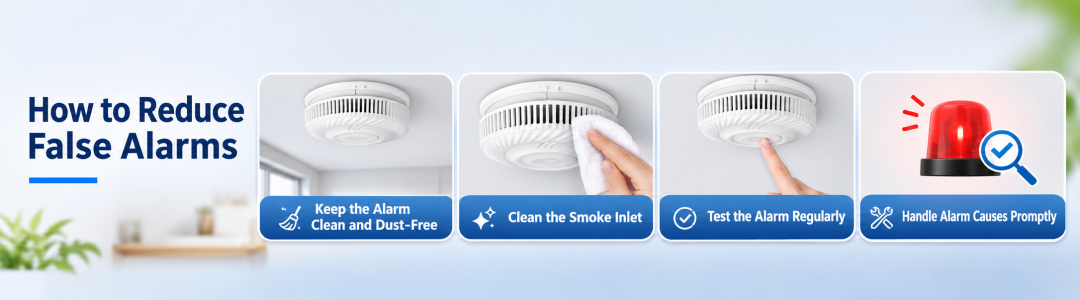
First, choose an appropriate installation location. Avoid areas directly exposed to cooking fumes, steam, or heavy dust, and install the alarm in accordance with applicable standards and the product instructions.
Second, keep the detection environment clean. Regularly inspect smoke inlet openings and the exterior of the device for dust and dirt. Clean the device using the method specified by the manufacturer, and do not disassemble the sensing chamber without authorization.
Third, pay attention to the condition of the device. Carry out regular functional tests in accordance with the instructions, and monitor low-battery warnings, contamination-related faults, and information about the device’s service life.
Finally, respond to alarm signals properly. When an alarm sounds, first check whether there is an actual fire. Only after confirming that there is no fire hazard should the silence function be used according to the instructions, and potential sources of interference investigated.
A smoke alarm should not be left powered off, have its battery removed, or be taken out of service for an extended period simply because it occasionally produces a false alarm. Otherwise, essential early fire warning protection may be lost.
5. Conclusion
False alarms from smoke alarms can be associated with various factors, including cooking fumes, steam, ambient humidity, dust accumulation, insect interference, installation location, and the operating condition of the device itself.
From a technical perspective, the key to reducing false alarms is not simply to lower detection sensitivity, but to improve the device’s ability to identify non-fire-related interference while maintaining the necessary fire detection capability.
Appropriate optical design, reliable signal-processing technology, proper installation, and regular maintenance all affect the real-world performance of smoke alarms.
For homes, offices, and other suitable environments, proper selection and maintenance of smoke alarms can help reduce unnecessary alarm activations and ensure that the devices provide the intended early warning when a real fire hazard occurs.
Post time: Nov-03-2026